|
A professional writer is an amateur who didn't quit. (Richard Bach)   Rules for Newcomers and Reminders for Veterans of the Writing Wars by Don Swaim
CONTENTS
Note: clicking on the title will take you directly to that section Shortly after the launch of the BCWW in the summer of 1998, it was clear many members were unfamiliar with the basics of formatting and structure—and in some instances elemental English grammar. Hopeful writers were submitting material on doubled-sided, single-spaced pages with unruly margins and weird fonts. One member submitted photocopies of her barely legible hand-written copy (she said she’d have someone type it for her some day). People with masters’ degrees—even PhDs—were passing out submissions with gross misspellings, errant punctuation, and sentence structure that would flunk a seventh-grader. It was embarrassing that otherwise intelligent people submitted such abominations yet appeared not to be embarrassed by it. What publisher would publish it, what agents would even glance at it? And why should workshop members undergo the ordeal of reading it? That led to a simple stylebook containing the basics when writing for publication or a workshop. There was little or no reaction to it after it was first distributed. One member scrawled notes on it before dropping it into the wastebasket. And he was one of the would-be writers who needed the stylebook the most. I received an email from a hopeful writer about a piece he planned to submit to a magazine. When he was told about some of the mistakes cited above, he said, “But I didn’t think writers had to worry about things like that because don’t they have people like plumbers to fix it?” The fact is, you are your own literary plumber. It’s hard enough to find publication even for decent work. Perhaps there are literary geniuses whose writing is so brilliant it doesn’t matter what they submit (such as a grocery list by Stephen King). If so, this stylebook’s author never met any of them, and, obviously, this stylebook would mean little to them.The BCWW Stylebook went through three printings before the final edition [now a collector’s item] was passed out in September 2007. Instead of printing a fourth edition it was posted on the BCWW website, which permitted expanding the stylebook over time. Additional content not in the original stylebook more than tripled its size. No stranger to writing stylebooks, the author wrote the editorial stylebook for the WCBS newsroom so long ago it was mimeographed. 
The industry rejection rate for all manuscripts is ninety-eight percent (or more). I was involved in a small literary agency a few years ago, so I speak the truth. As queries and manuscripts piled up on my desk and, yes, floor, the ugly, insulting, impersonal rejection slip became a necessity. I’m glad I got out of that racket, for which I was temperamentally unsuited. It takes a special intellect to comb through page and page after page of literary ineptitude to find that one decent gem. I tallied the number of printed pages of all twenty-nine general fiction and mystery novels reviewed in the March 21, 2003, issue of Publishers Weekly, the bible of the book world. The total number of pages was 8437. Divided by twenty-nine, that’s an average of 290.931 pages per book. In terms of manuscript pages, add on another 100 pages or so to reach the average length of 291 published pages. So how many words? Word processors make it easy to do a word count. In typewriter days days, you had to count the words in a line of text, then multiply that number by the number of lines on the page to get the page’s average number of words. Then you had to use that number multiplied by the number of pages in the manuscript. Generally, this is how the publishing world sees it: A novella is considered 7,500 to 40,000 words. A novel is considered 60,000 to 150,000 words. Anything between 40,000 and 60,000 words is in no-man’s land. Above 150,000 words you’re in War and Peace territory, and that requires a strong commitment from both the publisher and the reader. Publishers are loathe to publish novellas, which are sometimes considered long short stories, because of the disproportionate cost of printing them—although, understandably, Delillo and Bellow got away with it. In my opinion, your manuscript pages (assuming you’re using the equivalent of 12-point Times and not that ugly Courier similar to what lawyers use to write briefs) should number from 350 to 400. That should result in a novel of satisfactory length, even though I’m aware every story is supposed to be as long as it needs to be, so if you’re determined to write War and Peace you takes your chances. Most of us think chronologically—because that’s the way we live our often dull lives. We (1) wake up in the morning (2) eat breakfast (3) go to work (4) have lunch, etc. But a purely chronological approach to a story or a novel, at least at the start, rarely makes for compelling reading. Or maybe it could work. See? No one will know until it’s written. There are no absolute rules. How’s this for a lead? “It was raining when I woke up in the morning to the sound of an alarm clock.” Grabs you, huh? A weather forecast and getting out of bed. Oh hum. What you want to do is to jump ahead. Get into the heart of the drama, then work backward if necessary. Recall that crude but bold observation by the immortal writing teacher Gordon Lish: Don’t end with the “bj,” start with it. In his words, “The first sentence is the catastrophic equation, a sentential event...” Lish hated opening sentences that were mere statements of fact or mere description or just plain predictable. Write a first sentence that makes the reader anxious for more. Then write a paragraph that does the same. Easier said than done, right? Both my former editor (the late John Kahn of St. Martin’s Press) and my former literary agent (Laura Langlie) complained that too many of the manuscripts they received were pedestrian and ordinary. In other words, even when the writing was adequate the material simply lacked interest. Laura said she’d read a manuscript and tell herself, “So what?” Joan could usually tell by the first page when the story was amateurish, hackneyed, or just plan dull. Any one of the three was grounds for rejection—not to mention formatting that failed to conform to industry specifications. One of Joan’s biggest peeves was receiving a manuscript that the author had bound like a book, so that it took two hands to hold and read the thing. She wouldn’t even bother to open it, she said, because by binding it the writer signaled that he was presumptuous, and inevitably the manuscript was never any good. Writing is like a puzzle you’ve created for yourself, and only you can find the solution. It’s rather like confronting a maze and trying to reach the end without cheating and climbing over the wall. If you get stuck trying to begin a piece, think of storytelling in the traditional sense, when the storyteller begins, “Once upon a time...” You’re a storyteller and you have a story to tell. Put an invisible “Once upon a time...” at the beginning of your piece and go from there. As articulated in the Turkey City Writers Workshop’s manual: “Said” is one of the few invisible words in the language; it is almost impossible to overuse. Infinitely less distracting than “he retorted,” “she inquired,” or the all-time favorite, “he ejaculated.” Again from Turkey Hill: “The Tom Swifty”: A compulsion to follow the word “said” with an adverb. As in “‘We’d better hurry,’ said Tom swiftly.” Remember that the adverb is a leech sucking the strength from a verb. Tips from Elmore Leonard (in more detail elsewhere on this web site): 1. Never open a book with weather. 2. Avoid prologues. 3. Never use a verb other than “said” to carry dialogue. (see the “Tom Swifties” on this web site) 4. Never use an adverb to modify the verb “said.” 5. Keep your exclamation points under control. 6. Never use the words “suddenly” or “all hell broke loose.” 7. Use regional dialect, patois, sparingly. 8. Avoid detailed descriptions of characters. 9. Don’t go into great detail describing places and things. 10. Try to leave out the part that readers tend to skip. And now that you’re used to using the verb said, get rid of it if you can. It is overused, overworked, and often is superfuous—especially in dialogue in which it’s perfect clear who is speaking. Much better to use a bit of action to show who’s speaking: “Out of my house.” He went to the door and opened it. “Don’t darken my threshold again.”See? No “said.” The action shows conclusively who is speaking. Telling instead of showing violates the fundamental rule of good writing. Try to use dialogue and action to carry the story. Many writers, feeling compelled to offer vivid portraits of their characters, tend to cram the descriptions into a single paragraph up front. That’s so forced, so artificial. Space out the descriptive elements over a period of pages. While I am not a lawyer, it is clear by any number of court decisions that copyright protection is automatic the moment an original work, manuscripts or letters, is written or typed, published or not. As of 2022, copyright has expired for works published in the United States before January 1927—an expiration date that advances each succeeding year—and are now in the public domain. In formatting, the first paragraph of a story or chapter, or sections within a story or chapter, is usually positioned flush left on the page. Subsequent paragraphs are indented. If you doubt this, pick up about any book off the shelf (about ninety percent of them) and see for yourself. Typography guru Robin Williams writes: “The purpose of an indent is to warn the reader that a new paragraph is about to begin. If it’s the first paragraph, the reader does not need the clue—it’s redundant. This is another one of those deals where it might not look correct at first, but once you know it is correct and you apply it, other work will look foolish to you when the first paragraphs are indented.”Remember, you are using a computer, not a typewriter, so when you set your indents use the ruler, not the tabs or the spacebar. Even if they are not visible on the screen, using tabs and the spacebar create non-printing characters that could throw off the formatting, particularly when preparing an ebook. If you are writing a novel, each chapter should be separated by a page break, so do not run your chapters together. Some of the sources for the material below are Writing to Sell by Scott Meredith, Harper & Row, 1974, and Manuscript Submission by Scott Edelstein, Writers Digest, 1989. Meredith notes:
If the editor/agent is unhappy with the amateurish appearance of your copy he/she will probably make you unhappy. In other words, for you, rejection. Literary agent Noah Lukeman, in his article “The First Five Pages ” [posted in full here on the BCWW website], writes: It is a shame that small—and easily preventable—surface errors can be determinants for an entire book, can prevent you from being taken seriously. On the other hand, these smaller signs may be indicative of a certain broader sensibility. They may signify carelessness, sloppiness, ignorance, or defiance of the industry’s standards; that the writer doesn’t care enough to do the minimum amount of research to make a manuscript industry-presentable. Often when a writer’s presentation is careless, his writing is too. Punctuate carefully. Hint: punctuation almost always falls within quotation marks, which is the American, not the British, style. It goes without saying that the manuscript should be correctly spelled and punctuated, silly notions we were taught back in school. But you’d be shocked at what’s written by people, even allegedly educated ones, one would think would know better. Proofread your hard copy. Repeat: proofread your hard copy. You’ll see errors you won’t notice on the computer screen. [In fact, there may be some on this very page, for which I apologize in advance.] Don’t fasten the pages or chapters of a book-length manuscript in any way; leave the pages loose. [Note: when distributing multiple copies of a story to a writers workshop it’s okay to staple them.] Format book, magazine, and other titles per The University of Chicago Manual of Style. Usually, book and magazine titles are italicized: Sophie’s Choice. But use quotation marks for articles and TV shows: “The Beverly Hillbillies."
Title Page For novel
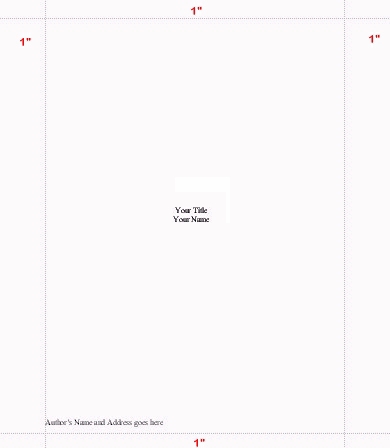 First Page. If chapter of novel author's name not used.
Note: opening paragraph is flush left 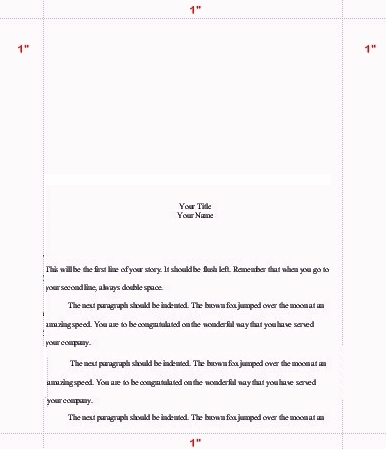 basic page with header
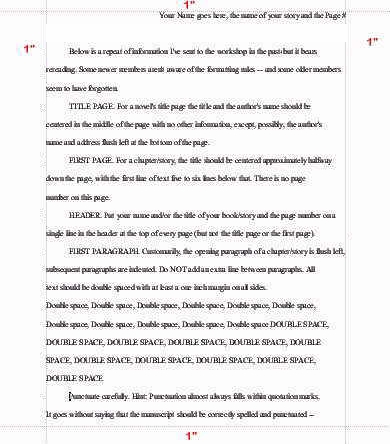
It would appear obvious that for material aimed at book or magazine publication, the line spacing should be evenly double-spaced throughout—with paragraphs (after the first) indented (as in the illustrations above). Material with an extra blank line between paragraphs is improperly formatted. If you think otherwise, look at any magazine or grab any book off the shelf. (This stylebook does add extra spaces between paragraphs, but it was designed for readability on a computer screen.) The extra space usually occurs when the writer hits the return key twice after completing a paragraph. If you find yourself in this situation, here’s how to repair it in MS Word after selecting the text in question: 1. On the menu bar go to FORMAT and scroll to PARAGRAPH While we're talking about spacing, remember there is just one space between sentences, not two. As Robin Williams explains in The Mac is Not a Typewriter: ...for years you’ve been told to hit two spaces after periods, and on a typewriter you should. But this [Mac or PC] is no typewriter. On a typewriter, all the characters are monospaced; that is, they all take up the same amount of space—the letter i takes up as much space as the letter m. On a Macintosh [or PC]...the characters are proportional; that is, they each take up a proportional amount of space.... So there is no longer that visual need to separate the sentences....Take a look at any magazine or book on your shelf—you will never find two spaces between sentences...If you have been putting two spaces between sentences instead of one, here’s an easy fix. Under EDIT go to FIND & REPLACE. In the box reading “Find What” make two spaces using your space bar. In the box with “Replace With” make one space using the space bar. Now hit REPLACE ALL and magically those errant extra spaces will disappear throughout, and you’ll have been transported to the post-typewriter age. 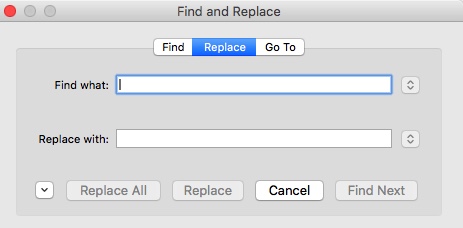
In fiction and literature, numbers are usually spelled out, especially if below 100—and always spelled out in dialogue. In dialogue this includes years, decades, money, street addresses, highways— you name it. Why are numbers always spelled out in dialogue? Because dialogue is composed of words, not arithmetic. It’s not a math text. Also, whether fiction or non-fiction, numbers must be spelled out if they begin a sentence. Yes, Stephen King used numbers (9/11) to start some sentences in his novel about cellphones and zombies. Steve can do anything he wants. We can’t. Exception. In David Leavitt’s brilliant The Indian Clerk (Bloomsbury 2007), a fictional account of the British mathematician Ramanujan, actual numbers abound in dialogue—and rightly so. How else could one compose a sentence such as: “Well, at least I’ve worked out what he’s up to with the damn 1 + 2 + 3 + 4 = –¾.” Use serif fonts for your text. A serif font uses small decorative embellishments on each letter, and is preferred in newspapers, magazines, and books because it is deemed more readable. The font you are reading now is the equivalent of Times-Roman, the most common serif font, although there are many similar fonts, such as Garamond, Baskerville, Caslon, Georgia, Bookman, Palatino. Do not use sans-serif fonts, which are likely to be found in headlines. The font you are reading in this sentence is the equivalent of Helvetica, a sans-serif font normally used for headlines, which you shouldn’t use in a regular manuscript. Therefore, avoid fonts like Arial, Lucida Sans, Verdana, or Calibri (not to mention the antiquated Courier). MS Word changed its default font from Times-New Roman to Calibri, which demonstrates how little MS understands the printed word. MS Word’s default font can be (and should be) easily changed. serif: T sans serif:T Avoid oddball fonts altogther, which are silly (hey, we know you’ve got a bunch of crazy fonts on your computer). Focus on content instead. And while we’re at it, unless yours is an illustrated story, leave out the homemade artwork if it’s to be sent to an agent or editor. When you print, use 12-point type, depending on the font. And, oh yes, remember to evenly double space and print only on one side of the paper (review the formatting tips above).
Grammatically, there are various ways of describing what’s going on. One helpful set of terms is essential vs. nonessential. When the identifier makes sense in the sentence by itself, then the name is nonessential and you use a comma before it. Otherwise, no comma. That explains an exception to the only-thing-in-the-world rule: when the words “a,” “an” or “some,” or a number, come before the description or identification of a name, use a comma. It’s correct to use a colon before a quotation, as well as a list, an explanation, or a main clause—particularly in scholarly writing, but never in fiction. Obviously, quotations and dialogue both require quotation marks—but quotations and dialogue are not the same. For example, in a scholarly work you might write: Grant, in his memoirs, wrote: “War is hell.” But in fiction you might express Grant’s thought this way:
Bottom line: in fiction and casual writing a comma is normally used before dialogue. American punctuation puts commas and most (but not all) other punctuation within quotation marks. See Item #20, Terminal Punctuation.
A workshop member raised the question as to whether the word “pop” should be capitalized in referring to a character in a recent story. For example in the sentence, "Forget about it, pop." In this instance the word would not be capitalized. “Pop” is not the man’s name, nickname, or title. It ranks with such descriptive appellations as fella, guy, buddy, mister. This brings to mind the common errors in capitalizing names. For example, Dad and dad. “Dad” is capitalized if it’s used as a name or nickname. For example: “May I have the car keys, Dad?” But not in: “My dad won’t give me the car keys.” Kinship names are lowercased, such as “Take the keys, son.” Or “Thanks, nephew.” Centuries and decades are not capitalized, i.e., the sixties and seventies, the twentieth century. However, the Roaring Twenties, the Gay Nineties.Are years capitalized when spelled out? No hard and fast rule. There are three variations: 1. No capitalization, e.g.: “the year eighteen sixty-six” For the titles of people: It’s “President Barack Obama,” but “Barack Obama, president of the United States.” Similarly, we make reference to the Obama presidency or the president.
It’s “Pope John XXII,” but later references refer to him as “the pope.” It’s General U.S. Grant. But then... “The general won the war for the union.”
But there are some exceptions based, not on logic, but tradition. It’s “Prince of Wales,” not “prince of Wales.”
The names of the seasons are not capitalized unless they are personified, such as: “Then Spring, with her warm showers, arrived.” Honorific titles are capitalized: “Your Honor.” But not “sir.” Descriptors denoting roles are not capitalized preceding a name: it’s “the historian Arthur Schlesinger,” not “the Historian Arthur Schlesinger.”COMMON & PROPER NOUNS. Common nouns are not capitalized, except in spiritual or religious disquisitions aimed at a specific audience. Take any novel off the shelf and you will never see common nouns, such as soul, light, universe, angel, heaven, hymn, etc., capitalized. Nor are references to God or Jesus, such as him or he, capitalized. Proper nouns — names of people, cities, states, brand names, etc. — are capitalized. PLURALS OF PROPER NOUNS THAT INCLUDE A GENERIC TERM. In a return to an earlier version, the 16th edition of The Chicago Manual of Style asserts that the generic term in a proper noun is uppercased if used in the plural (e.g., Fifty-Fifth and Fifty-Seventh Streets, the Thames and Mersey Rivers, the American and French Revolutions). MORE ABOUT GOD. It has been argued that the word god is always capitalized. It is not. Only when God is referred to as an entity or a name. Never when used in the vernacular, such as goddamned, godforsaken, for god's sake. Ditto the word christ or jesus. Worry not. Even if God has read this stylebook, he will not strike you down. Also when referring to God, do not capitalize he or him, unless you are writing some biblical tract, which is not in the purview of this stylebook. BIRD NAMES. The consensus seems to be that the names of specific birds are capitalized (Great Horned Owl), but general species are not (owls). Or Great Blue Heron, and then, herons. Red-tailed Hawk, then hawks. POLITICAL REFERENCES. The Congress and the Senate are capitalized, but not as verbs, such as congressional or senatorial. How do we figure all this out? There’s an extensive section on the proper use of personal names and titles in The University of Chicago Manual of Style (from which came most of these notes), the basic editing tool for writers and editors.
Apostrophes are always used in contractions. For example: it’s [as it is, as opposed to the possessive, its]. But what about contractions that begin with an apostrophe? There’s no dedicated key for this, so you’ll have to find the right key combination to do it (mine is option-shift-bracket). If you don’t do this you’ll wind up with a forward single quote mark instead of an apostrophe, which is not only wrong but amateurish. So it’s ’bout, not ‘bout. If you can't figure out the key combination for single-word contraction, here’s a sneaky way of doing it: Type ain’t. Delete the ain and after the remaining apostrophe replace the t with whatever contraction you want. It works.
Ellipsis: a triple-dot punctuation mark [...]. It is a single punctuation mark, not three periods typed in a row. On a computer keyboard, the key combination to create an ellipsis mark is usually: option-semicolon. [Typing three periods in a row can be broken up or hypentated by your word processor, but an ellipsis cannot.] An ellipsis is used to show an incomplete sentence, not to replace standard punctuation. In non-fiction, it usually indicates material omitted between sentences. Fiction writers in dialogue use an ellipsis to show that the character who is speaking has not completed his sentence. Like all punctuation marks, an ellipsis is always attached to the sentence it follows and is never separated by a space. Bottom line: never use dot-dot-dot in place of standard punctuation, and use an ellipsis mark only where applicable.
By the redoutable Lynn Truss, author of Eats, Shoots & Leaves: To those who care about punctuation, a sentence such as Thank God its Friday (without the apostrophe) rouses feelings not only of despair but of violence. The confusion of the possessive “its” (no apostrophe) with the contractive “it’s” (with apostrophe) is an unequivocal signal of illiteracy and sets off a simple Pavlovian “kill” response in the average stickler. The rule is: the word “it’s” (with apostrophe) stands for “it is” or “it has.” If the word does not stand for “it is” or “it has” then what you require is “its.” This is extremely easy to grasp. Getting your its mixed up is the greatest solecism in the world of punctuation. No matter that you have a PhD and have read all of Henry James twice. If you still persist in writing, “Good food at it’s best,” you deserve to be struck by lightning, hacked up on the spot, and buried in an unmarked grave. The rule here is a simple one. You are allowed to use one exclamation point for every 100 pages of copy!
American English mandates that punctuation falls inside closing quotation marks, unlike British usage, which is inconsistent, scattershot, and harebrained. CORRECT: “I went to the store,” she said. (American)It’s time that Americans pull rank over their British relatives and wean them from their disgusting and confusing habit.
Back in the days of the typewriter there was only one way to indicate that a word, words, or portion of prose was to be italicized. That was to underline. Those days are gone forever, thanks to the computer. Now, when you mean to italicize it should be done without resorting to old-style underlining. If some cranky editor with one leg in the past insists that your copy be underlined, fine. Then he or she will be the one who’ll eventually have to repair it. Italics, by the way, should be used sparingly and never used for large blocks of text. Too hard and too annoying to read.
Books and magazines use smart quotes, so writers should too. Reserve straight quotes for computer blogs and the like, which aren’t fussy and don’t care about things like typography. Straight Quotes: ''That's a 'wrong-headed' move.''Somewhere in your word processor, probably in preferences, there’s an option to turn on smart quotes (sometimes known as curly quotes). The only problem is typing the symbols for feet ( ' ) and inches ( '' ) because then they’ll turn out to look like smart quotes. But you can figure that out.
Don’t write ’em. A run-on sentence is one in which two or more clauses are joined without proper punctuation or lacking conjunctions (“and” or “but”). Contrary to common belief, a sentence isn’t necessarily a run-on just because it’s long. Jack Lynch, author of Guide to Grammar and Style, has a particularly good explanation with examples: Just as there’s nothing inherently wrong with a long word, there’s nothing wrong with a long sentence. But it has to be grammatical. A run-on sentence is ungrammatical, not just long. It often happens when two sentences [or more] are run into one without the proper subordination or punctuation. Two sentences glued together with only a comma produce a comma splice, a kind of run-on: for instance, “The semester runs through April, the break begins in May.” There are a number of ways of fixing this comma-splice: “The semester runs through April. The break begins in May.”; “The semester runs through April, and the break begins in May.”; "The semester runs through April; the break begins in May.”; “The semester runs through April, whereas the break begins in May.” And so on.
It is all right, not alright. From the American Heritage Dictionary: “All right, usually pronounced as if it were a single word, probably should have followed the same orthographic development as already and altogether. But despite its use by a number of reputable authors, the spelling alright has never been accepted as a standard variant, and the writer who chooses to risk that spelling had best be confident that readers will acknowledge it as a token of willful unconventionality rather than as a mark of ignorance.” 25. HYPHENS by Bill Donahue Hyphens are critically important to a well-written work, but they can confuse the reader when used incorrectly. Besides that, the overuse or underuse of hyphens can make a graceful sentence seem ugly, and its writer uninitiated. A good rule of thumb: If a hyphen adds clarity or reduces ambiguity, especially in a sentence with compound modifiers, use it. Example: A well made sandwich tastes delightful. In this sentence “well made” acts as a compound modifier, as both words modify the noun “sandwich,” so the proper usage would be “a well-made sandwich.” Otherwise, the reader would have to work harder than she/he needs to; in this case, the missing hyphen may cause the reader to wonder if “well” is a noun or adjective, thinking the writer might have made a mistake. One exception applies to adverbial phrases containing an “-ly” word, as in “a smartly dressed woman” or “a painfully stupid president.” Because the adverb (“smartly”) automatically describes the adjective (“dressed”), a hyphen would be redundant. The same rule applies to the word “very,” meaning there's no need to hyphenate “a very good glass of Bordeaux.”
Yes, the word that is overused and frequently unnecessary, but it cannot be blindly removed without potentially compromising clarity. When a sentence is correct, whether that is used or not, it’s best to leave it out. But many times that is vital in order to make the sentence understandable. Some examples: Daddy told me that on the day I was born, Lynda was in the hospital. Daddy told me on the day I was born, Lynda was in the hospital.
Linda said that a year before his death Charlie received instruction and was baptized a Catholic. Linda said a year before his death Charlie received instruction and was baptized a Catholic. Some examples from Patricia O’Connor’s Woe Is I: Bob said that on Friday he would confess. Bob said on Friday he would confess. Hilda thinks the idea stinks and Horace does too. Hilda thinks that the idea stinks, and Horace does too. Conclusion: good writers use (or don't use) that with the discretion the writing craft demands.
I was reading a manuscript submitted by a hopeful writer in New York who had composed a hard-boiled detective novel. All of his sentences were short and tight and unadorned. I walked into Louie’s bar. Louie wasn’t there. I sat on a stool and ordered a beer. I lit a cigarette. Then she walked in. She wore a red dress. She sat on the next stool and ordered a Bicardi. I said, I think I know you. She said, I don’t think so. Then Butch came in and shot her. After pages and pages of narrative like this I began to feel tired, hypnotized. I knew the sentence structure was by design. But I found the staccato, machinegun approach virtually unreadable. Assuming the writing is clear and the language is accessible, you can control the rhythm by adjusting the length of the sentences. Short, punchy sentences hasten the pace, while longer more language sentences slow it down. In action scenes you would probably want shorter and shorter sentences leading up to the conclusion, the same with dialogue. For sleepy, romantic scenes longer, more languid sentences. Therefore, the pace of the narrative is controlled by the pace the writer uses as he contrives various situations for his characters.
Foreshadowing is the process by which the writer tells the reader, either directly or through subtlety, what lies ahead. An example of ominous foreshadowing, in which the reader learns something bad will happen but not what: As the outstretched wings of the enormous bird cast shadows over us, I knew something fateful was going to happen. An example of foreshadowing in which is reader is actually told what will occur: He was to bring down upon us cops, congressmen, crooks, and cowards—and some were one and the same. Here’s a variation of foreshadowing: the cliffhanger, used to great effect during the golden age of the radio serials: Oh, oh, it looks like Mister Evil is going to get his way. Will Captain Midnight survive in the hyperbolic chamber without oxygen? And what about the little man in the black hat with the umbrella? Will he play a role in saving Billie and Betty from the killer ants?
One of the things that stands between a bad writer and his or her hopeful reader is a lack of clarity. The definition of clarity is: clearness of thought or style; lucidity. You would think this would be self-evident in one’s writing, but it’s not. For a number of reasons.
Once, when I was a hopeful young broadcast news editor in New York, I received some copy from an older writer who had had a long newspaper career, and now was facing deadline pressure he only could imagine at the old Herald Tribune. His copy, something dealing with a budget controversy in New Jersey, made no sense to me. So I showed him his script and asked him what he meant. He admitted that he didn’t know either, that he just had to get something out. My response was that if the writer didn’t know what his own words meant, and if the editor couldn’t decipher it, then how would a listener comprehend? Moral: not only stand behind what you write but understand it. When I complimented a successful published writer (future Pulitzer prize-winner Michael Cunningham) on how smooth and flowing his prose was, he responded that the trick was in making it look that way, which is why he spent three years working full-time on his manuscript.Writing is no occupation for wimps. And more than anything else, since it reveals our own flaws as writers, it requires enormous thought and effort in order to stand up to scrutiny. Writing is more competitive and difficult than most people imagine, especially critics who say, “So-and-so has knocked out a new novel.” Knocked out? That I’d like to see.
Overstating the obvious will sink a manuscript. Some years ago, a workshop submission contained an excruciatingly long paragraph describing someone lighting a cigarette. We all know how to light a cigarette (everyone’s watched Casablanca and every other Bogart movie). I cite the actual paragraph—but respectfully, because there was a lot of decent material in this writer’s novel. Primarily, the paragraph was intended to set up the cigarette brand, thus the era in which the story was set:
Instead, how about:
In the same context, think about writing, in the minutest detail, this: a description of a woman using a can opener to open a container of tomato soup. The only one who would benefit from a chronicle like that would be an aborigine, for whom the paragraph might serve as a training manual. We shouldn’t waste words writing about things everyone knows about, but things most of us don’t know about. But there are exceptions. How about writing about a man who comes home from work, carefully removes his shoes and places them neatly side by side in the closet, meticulously puts his pocket change by value on the dresser, painstakingly hangs up his jacket and trousers, and on and on. Yes, we all know about hanging up clothes, yet the methodical nature by which he does it sheds light on his excessive character and may warrant the detail. On the other hand, elaborate detail may not be warranted to describe the clod who returns from work, throws his jacket on a chair, flops in the sofa, pops his shoes off, and says, “I’m pooped, honey, gimme a beer.” Our natural wordiness as writers needs attention and correction through rewriting and rewriting; getting rid of all those superfluous words that float to the tops of our paragraphs like ugly, rendered fat. And—at the risk of stating the obvious—we should strive to find new and fresh ways of description. This is where the poets often have the edge, but it doesn’t have to be that way. Some guides to writing insist that the number of words in a sentence or paragraph should be reduced to their bare essentials. Not so in creative writing, which is not the same thing as posting a telegram (remember those?) or constructing a business letter. Colorful descriptions with well-placed adjectives and clever linguistic turns make the difference between beautiful writing and an interoffice memo.
Phrases such as “I looked at him” or “She stared at me” are sometimes used repetitively by writers intending to provide a modicum of action during stretches of dialogue or narration. If a character “looks” at another must be a reason for it. If a character “stares” at another there also must be a reason. If there’s no reason for a character to perform those actions leave it out. Otherwise, it’s lazy writing, needless words or phrases that expand verbiage unnecessarily but do nothing to advance the story.
The debate continues: Is it “I couldn’t care less” or “I could care less”? Both are clichés, but one is more right than the other. The winner is: “I couldn’t care less,” which means not to care at all. The other means to care at least a bit, which in this context doesn’t make much sense. The Oxford dictionary recognizes “could care less” as an American colloqualism.
Some of the best advice about using flashbacks comes from popular fiction writer David Morrell. He says: “By definition, flashbacks impede the forward movement of the story... Unless the book is about the nature of time and/or memory, as in Faulkner's Absalom, Absalom!, flashbacks are a dangerous interruptive strategy. Whenever you’re tempted to use one, try to find every reason in the world not to include it.” An opening sentence of a chapter submitted to the BCWW had a young woman riding in a Model T Ford with her friend in Trenton, New Jersey. But the next sentence was a one-line flashback explaining how she’d taken the train to Trenton and had been met by her friend at the railroad station. There was no reason to interrupt the narrative with the flashback. It would have been just as easy to start the chapter with the woman riding on or getting off the train. Short “disguised flashbacks” like that can be annoying. A red flag’s in order whenever we’re tempted to use “had” in a sentence—a mini-flashback.
1. It’s a bad idea to reply to criticism of your work. Your time is too valuable. 2. It’s a good idea to use criticism of your work as a tool, applying the best of it, discarding the worst. 3. It’s a good idea to critique other people’s work. The exercise helps to give you insights into your own. 4. It’s a bad idea to attempt to analyze the writer’s character when you criticize his work. Most likely you’ll be wrong.
Few writers, famous or unknown, have failed to avoid the process of rejection and criticism. Ambrose Bierce wrote, “If rejection wounded, all writers would bleed at every pore.” As a writer, you’re an artist (or hope to be). Publishers are mere business people. Rejection hurts, but it’s rarely personal, and we sometimes delight in the disastrous mistakes made by agents and editors. The better to stick it to ’em. In a biography of J. D. Salinger, Paul Alexander writes that in 1950 editor Robert Giroux of Harcourt Brace loved Salinger’s The Catcher in the Rye and wanted to publish it. But Giroux’s boss at Harcourt, Eugene Reynal, didn’t like the novel and overruled his subordinate with the caustic question, “Is Holden Caulfield supposed to be crazy?” The book was snapped up by Little Brown. The Catcher in the Rye became a lasting literary and commercial success. Giroux went on to become a respected partner at Ferrar Straus and Giroux while Eugene Reynal wound up as the publishing jackass of the century. Further, Salinger’s editor at The New Yorker, which published many of his stories, declined to publish any excerpts from The Catcher in the Rye in the magazine. The editor, Gus Lobrano, claimed that Salinger wasn’t “ready” to write a novel and that he was “imprisoned” by the novel’s mood and scenes (whatever that means). Some of the critics, people paid (often by merely receiving a copy of the book) to expose their personal opinions and biases, utterly failed to understand The Catcher in the Rye. James Stern in The New York Times Book Review grumbled that the book was “too long” and “monotonous.” Anne Goodman in The New Republic wrote “...in a writer of Salinger’s undeniable talent one expects something more.” T. Morris Longstreth in The Christian Science Monitor complained that the novel “was not fit for children to read.” In The Nation, Ernest Jones dismissed it as “predictable and boring.” R. D. Charques in the Spectator claimed “the tale is rather too formless to do quite the thing it was evidently intended to do.” And The Times Literary Supplement decided that Salinger “has not achieved sufficient variety in this book for a full-length novel.” The book sells an estimated 100,000 copies every year. The estimable but hermitic Mr. Salinger lived on it until his death.
After reading unhelpful critiques of my own work, it dawned on me that many of us, as writers or critics, weren’t completely sure of what to look for in terms of analyzing the material. So I set up an eight-step checklist (not quite a twelve-step program) to help analyze the work so it could better be critiqued—thus, allowing for a better grasp of our own work. No one has to use it, but I’m pretty sure the checklist covers much of the ground (some explained above in more detail) needed in order to articulately critique submissions to a workshop. The checklist applies to non-fiction as well as fiction: 1. Compelling beginning — commanding our attention so that we want to read more
A writers workshop has all the elements for a positive environment in which creative people share not only their art but writerly opinions and occasionally helpful advice. For a congenial atmosphere it’s vital that criticism of another’s work be directly solely at the writing, not the writer. Avoid the temptation to psychoanalyze another writer, much less dwell personally on the writer’s race, religion, sexual orientation, or national heritage. Proper etiquette in a workshop is for the writer to remain silent until all the critiques of his/her work are over, at which time the writer might wish to respond, if only to clarify misconceptions. A writer should listen respectfully to the critiques of his/her work and adopt what seems to be valuable and discard the rest. To react defensively to workshop criticism isn’t helpful. Similarly, those delivering their critiques should not be interrupted or challenged. Courtesy, the kind you would want, is the key. Needless to say, private conversations while others are trying to hear critiques, as well as the ungodly noise of a cellphone, breach workshop etiquette. Membership in a workshop is a tradeoff. You receive a critique of your work in exchange for giving a critique. Therefore, members are expected to read the others’ work no matter what the subject, theme, or genre. Someone refusing to read another writer’s work “because I never read science-fiction or fantasy or mystery or history or romance ” won’t wash. See the eight-step guide for critiquing another’s work above. Participating in a workshop means understanding how to give and take constructive feedback, and should be part of a writer’s lifelong learning process.
This is our usual procedure when bad weather forces a cancelation of our regular Tuesday meeting: We try to reschedule the meeting to the following THURSDAY, depending on room availability. If that is a no-go we try to reschedule the NEXT WEEK on the subsequent Tuesday. If we do postpone we announce it as soon as we know on Facebook plus the main page of the BCWW website. Submissions for the next scheduled meeting are still due on the date of the cancelation, however — as expected. [Requirement for BCWW members only — other websites may have different rules] Your submissions must be titled in such a way that they can be sent to the server via a file transfer program (FTP). The Internet’s finicky about file names — plus someone (guess who?) has to keep track of all the posted files. Therefore, submissions must be uniformily titled. (Prevously, some submissions were haphazardly labeled such as: “Chapter 10,” “In Plain Sight,” “latest chapter,” “synopsis,” etc.) Here are examples of the proper way to title a file for submission to the BCWW (the date should be that of the submission date): Save (or export) your Word or Pages files as .rft or .doc [but not .docx] documents with files names like these: dyen-submission-6-15-11.docHyphens are ok, but no dots other than the one before the .rtf file extension. And no capital letters. Also, no blank spaces between words. (Yes, the ’net is fussy.) And you thought this stuff appeared online magically.
Don’t. When you submit to agents or editors they’ll want to know up front what your submission is all about, its genre, whether it’s a memoir, short story, novel, etc. Why should your fellow workshop members have to guess at what you are up to? It’s not fair to them, it’s a time waster, and you won’t be getting the sort of feedback you joined the group to get in the first place.
The basic reference used by nearly the entire publishing industry to edit manuscripts is The University of Chicago Manual of Style. Every writer should own a copy as the essential tool of the craft. Writing is a craft, isn’t it? [Note: this is a complicated, voluminous volume, and even the computerized edition can be difficult.] Also recommended: The New York Public Library’s Writers Guide to Style and Usage, and, of course, Strunk and White’s The Elements of Style. And for dolts like me who are constantly grappling with the English language, Patricia T. O’Connor’s Woe is I is a must. Ambrose Bierce: “The first duty of an author is to be interesting. Every sentence that he writes must be of interest. He who does not obey this First Commandment of the literary megalogue will incur the inevitable punishment of not being read.” [italics added] Martin Amis [after wearily judging a short story contest]: “It’s hard to say whether standards of literacy have actually declined. Certainly a morbid fear of dictionaries would seem to be abroad. What has changed, perhaps, is the attitude to linguistic law. Thirty years ago the would-be writer might at least concede that correctness was something worth aiming at. Sometimes, of course, one read on out of sheer disbelief at the concerted talentlessness [italics added] nestling on one’s lap. And often, certainly, it was human interest, not literary relish, that compelled one [to continue reading]. I was reminded how astonishingly intimate the business of fiction is, more intimate than anything that issues from the psychiatrist’s couch or even the lovers’ bed. You see the soul, pinned and wriggling on the wall.” John Steinbeck: “It takes only the tiniest pinch of encouragement to keep a writer going, and if he gets none, he sometimes learns to feed even on the acid of failure.” My (thoroughly amateur) essay on screenwriting HERE  
© Bucks County Writers Workshop
|
