HOW TO READ A SCREENPLAY
by Don SwaimI don't write screenplays. I'm not setting myself up as an expert on screenplays, although I've read a few. However, a young screenwriter once joined the BCWW and presented, yes, a film script. Other than the fact it was about zombies, it flummoxed some of the members who complained they'd never read a screenplay and had no idea how to critique one. The horror, the horror! However, film writing is storytelling at its most elemental -- and in some cases its most complex. But a good story is a good story, and there's no reason a decent writer can't identify a good story when he or she sees it. Here are a few tips to get the idea about how to decipher a screenplay and understand the storyline.
A screenplay is a blueprint for actual filmmakers rather than the manuscript more familiar to fiction or creative non-fiction writers or editors. This is why a screenplay looks more like an archiac typewriter blunder (see below) rather than today's formatting for any other piece of writing. (Aside: there's no logical reason for a screenplay's font, courier, to resemble a typewriter's of twenty-five years ago as opposed to what computers now excel in, but it'll pass.) Typing errors, misspellings, and incorrect grammar weigh against a screenwriter just as much as a fiction writer.
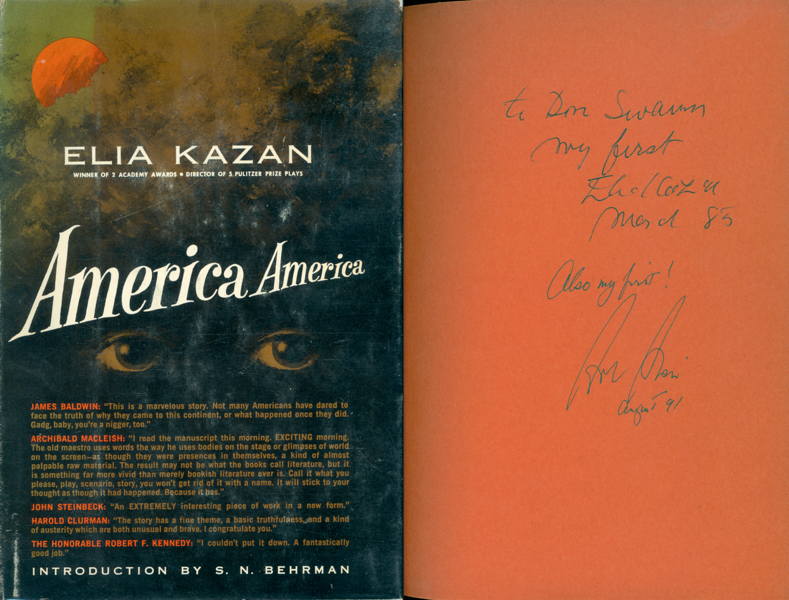
Digression... Screenplays published in book form often look different from actual film scripts. The great director Elia Kazan's America America, the book's first edition published by Stein & Day in 1961, is an example. My running the risk of sounding supercilious or as a name-dropper, Elia Kazan inscribed to me America America on March 5, 1985, scribbling, "My first." On August 29, 1991, Kazan's publisher Sol Stein signed the same book writing, "Also my first." Yes, Kazan's first book was also the first book published by Stein & Day (now defunct). (The Kazan and Stein interviews can be heard online at Book Beat)
Back to the point of this exercise...
The standard film length is 100 minutes, which translates to approximately 120 pages of script. The pages must be numbered.
The first part of a screenplay is usually:
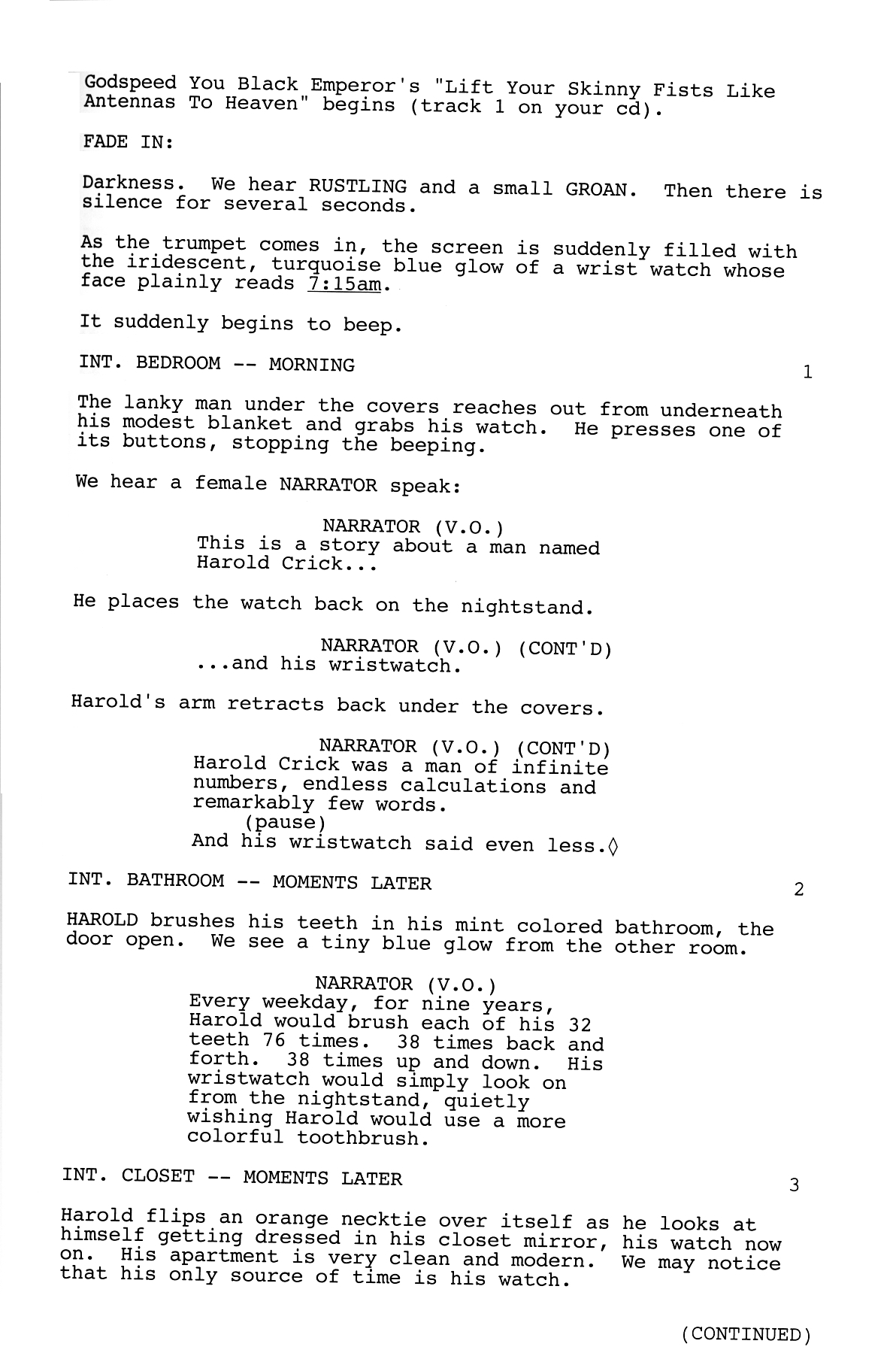
FADE IN (in caps flush left)
Below that is in information line in regular letters. It contains:
INT or EXT in caps for interior of exterior shot. As well as DAY or NIGHT. Then where the scene takes place, usually one word in caps: BEDROOM, BACKYARD, etc.
Then a description of the SHOT (or scene) with directions such as CLOSE SHOT, MEDIUM SHOT, FULL SHOT. The instructions are in caps but the actual description is in standard type, flush left.
If there's noise or music in the scene they're also indicated in caps.
Each scene is numbered to the left -- or sometimes on the right as in the example below.
When an actor appears his or her name is in caps in centered in the page. Below the name, where needed, is a description of the actor's mood in parenthesis: angry, laughing
And below that is the actor's (or narrator's) dialogue, not in caps, also centered with wide margins on either side.
Here's a sample of the first page of the 2006 shooting script from Stranger than Fiction by Zach Helm, a decidedly literary movie starring Will Farrell, Emma Thompson, Dustin Hoffman, Maggy Gyllenhall, and Queen Latifa. Notice that it incorporates all of the elements cited above. Where it states "narrator V.O." it refers to an unseen narrator describing the action (voice over).
There will be other items in the script, but these are the basics.
Once one sees and understands this basic layout, reading a screenplay is relatively easy and fast as there's little or no description of internal motivation. But the same good story-telling rules apply to screenwriting just as much as to regular fiction.
A final note. There are any number of specialized software programs for screenwriters, the most notable being Final Draft at about $80 list. I recently saw a $20 app for Macs called Highland. The fact is, with a minimal amount of work you can set up a template using Word or Pages, which effectively do the same thing, although without bells and whistles.
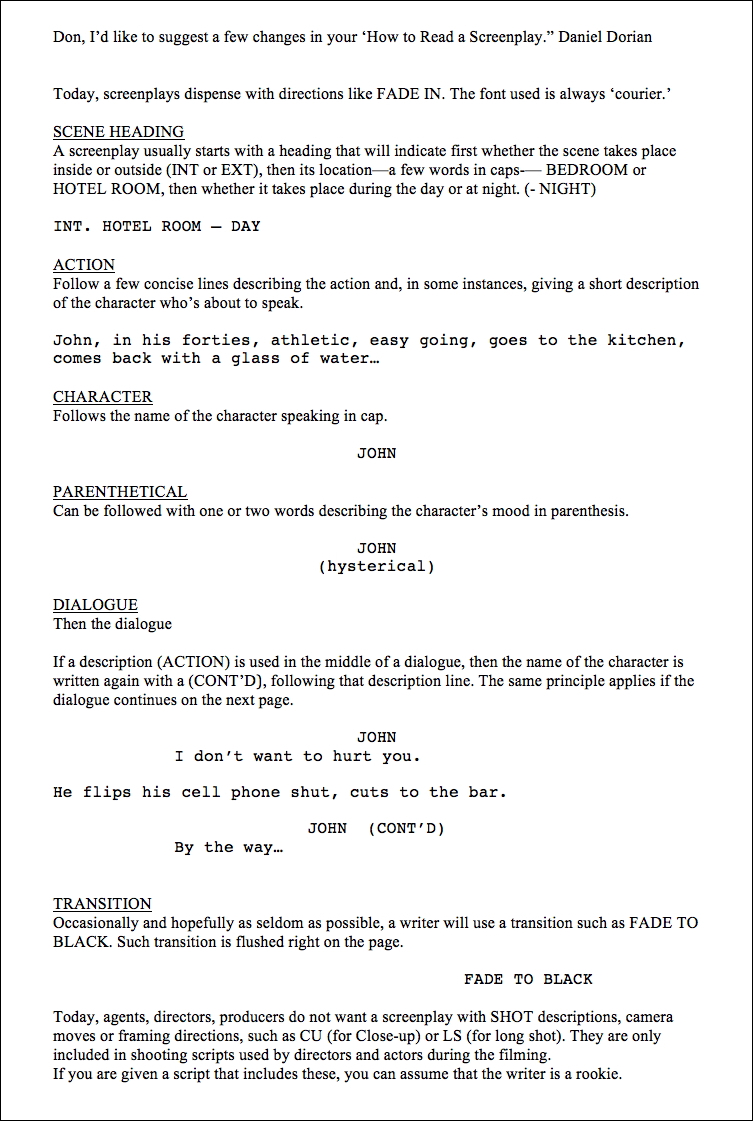
ADDENDUM by DANIEL DORIAN